


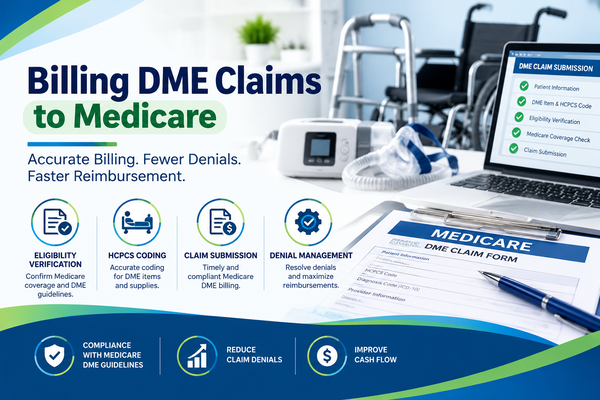
Billing DME Claims to Medicare
Billing for durable medical equipment (DME) is one of the areas of Medicare subject to the strictest regulation, and the rules continue to tighten. Between rigorous provider enrollment requirements, documentation standards, and an ever-growing list of items requiring prior authorization, a single missing detail can lead to a claim denial or worse an audit. For providers and practices billing Medicare for DME in 2026, understanding the entire process from enrollment to claim submission is essential to protecting their revenue.
This guide details the steps required to correctly bill Medicare for DME, the associated documentation and coding requirements, and the common errors that lead to denials.
What Counts as DME Under Medicare?
Durable medical equipment refers to equipment that is medically necessary, capable of withstanding repeated use, primarily intended for medical purposes, and generally not useful to a person in the absence of an illness or injury. This category includes items such as wheelchairs, hospital beds, oxygen equipment, CPAP devices, and diabetes supplies. Medicare Part B covers 80% of the approved amount for durable medical equipment; the patient is responsible for paying the remaining coinsurance after the deductible has been met.
Step 1: Supplier Enrollment and Accreditation
Before a single DME claim can be submitted, the provider must be properly enrolled in Medicare. Key requirements include:
- Enrollment through PECOS (Supplier Enrollment, Chain, and Ownership System), which establishes the supplier's National Supplier Clearinghouse (NSC) number: the unique identifier linked to each claim submitted.
- Accreditation from a CMS-approved accrediting body, confirm that the provider complies with federal quality, safety, and operational standards.
- A surety bond of at least $50,000 per practice location, required to maintain active billing privileges.
- Ongoing compliance with DMEPOS supplier standards, including the maintenance of physical facilities, trained personnel, and documented inventory control processes.
Suppliers must also take into account the "36-month rule": if a durable medical equipment (DME) supplier undergoes a change in majority ownership within 36 months of its initial enrollment, CMS generally requires the new entity to re-enroll rather than transferring existing billing privileges—a process that can lead to a billing interruption if not planned for in advance.
Step 2: Physician Order and Medical Necessity Documentation
Every item of durable medical equipment (DME) billed to Medicare must be supported by:
- A Standard Written Order (SWO) from the treating physician, specifying the article, the diagnosis, and the relevant clinical details.
- A face-to-face visit with the supplier placing the order before requesting durable medical equipment (DME), for those items that require it.
- Medical necessity documentation in the patient's medical record that clearly justifies why the equipment is needed.
Missing or incomplete documentation particularly the written order or proof of delivery remains one of the most frequent reasons why durable medical equipment (DME) claims are denied or flagged during audits.
Step 3: Accurate HCPCS Coding
Unlike the standard CPT coding used for most medical services, billing for DME (Durable Medical Equipment) relies on Level II HCPCS codes, which identify specific categories of equipment and supplies. The use of outdated or incorrect codes is a leading cause of Medicare claim denials for DME; therefore, verifying current code sets prior to submission is essential. Common coding elements include:
- The correct HCPCS code for the specific item or accessory
- The appropriate modifiers (such as the RR modifier to indicate rented equipment)
- K-codes for specific DME accessories and supplies, where applicable
Step 4: Prior Authorization Requirements
Prior authorization has become an increasingly fundamental aspect of DME (durable medical equipment) billing. As of 2026, CMS (Centers for Medicare & Medicaid Services) requires prior authorization as a condition of payment for a growing list of high-risk DMEPOS items; this list is expanded periodically. Key points providers should know:
- Prior authorization decisions for DMEPOS under the traditional Medicare program are now typically issued within 7 calendar days, aligning with the
- timeframes used for standard prior authorization requests in Medicare Advantage.
- When prior authorization is approved, the provider receives a Unique Tracking Number (UTN), which must be included on the final claim.
- Starting October 15, 2026, CMS will also implement a trial prior authorization process for certain DMEPOS items billed by newly enrolled providers and those undergoing specific changes of ownership, in addition to existing prior authorization requirements.
- Not all DME items require prior authorization; providers must verify the requirements for each specific HCPCS code before delivering the equipment.
Step 5: Claim Submission
Most DME claims are submitted electronically via Electronic Data Interchange (EDI) to the DME Medicare Administrative Contractor (DME MAC) for the provider's region. Claims must include:
- The provider's NSC number
- The correct HCPCS codes and modifiers
- The UTN, when prior authorization was required
- Proof-of-delivery documentation, retained in the files for audit purposes
Common Reasons DME Claims Are Denied
- Missing or incomplete standard written order
- Lack of documentation justifying medical necessity
- Outdated or incorrect HCPCS codes
- Missing mandatory modifiers, especially for rented equipment claims
- Claims submitted without required prior authorization or UTN
- Claims submitted beyond Medicare’s timely filing deadline (generally one year from the date of service)
- Missing or incomplete proof of delivery
Best Practices for Clean DME Claims
- Periodically verify the provider's enrollment and accreditation status to avoid interruptions in billing privileges.
- Confirm prior authorization requirements before delivery, rather than after submitting the claim.
- Keep HCPCS code references up to date, as both codes and coverage policies change frequently.
- Maintain comprehensive documentation including the Supplier Written Order (SWO), proof of delivery, and notes on medical necessity in preparation for a potential Medicare audit, which can cover a period of up to seven years.
- Track claims by denial reason to identify recurring process deficiencies, rather than addressing issues on a case-by-case basis.
Final Thoughts
Successfully billing Medicare for Durable Medical Equipment (DME) claims requires far more than simply submitting a code and awaiting payment; it demands meticulous attention to enrollment status, documentation, coding accuracy, and an ever-expanding set of prior authorization rules. Providers and practices that establish robust initial processes around these requirements are far better positioned to avoid denials, successfully navigate audits, and maintain a steady flow of reimbursements.
At MedMaxBill, Inc., we help healthcare providers and suppliers manage the complexities of Medicare DME billing from documentation and coding accuracy to prior authorization tracking and denial management. If DME billing is causing unnecessary delays or denials for your practice, our team is ready to help you streamline the process.
