


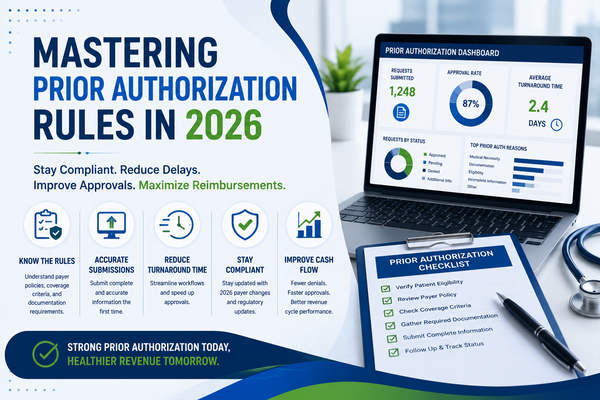
Mastering Prior Authorization Rules in 2026
Few stages of the revenue cycle generate as much frustration among medical practices, staff, and patients as prior authorization. A single delayed approval can postpone care, keep billing staff tied up on the phone with payers, and if overlooked entirely result in a claim denial after the service has been provided. New federal requirements taking effect in 2026 are transforming the prior authorization process, making it more important than ever for practices to understand the regulations and establish workflows that align with them.
This guide explains what prior authorization actually entails, how the process has changed this year, and what steps practices should take to prepare for these changes.
What Is Prior Authorization?
Prior authorization meaning, In essence, it refers to the requirement that a healthcare provider obtain approval from the patient's insurance company before providing a service, performing a procedure, or administering a specific medication. This process is also commonly known as precertification or pre authorization, depending on the payer. Without this authorization, the payer could reduce the reimbursement or deny the claim entirely, even if the service was medically necessary.
Prior authorization applies to a wide range of services, including advanced diagnostic imaging, certain surgical procedures, durable medical equipment, and prior authorization for medication particularly specialized medications and high-cost treatments.
Why Prior Authorization Rules Are Changing in 2026
For years, prior authorization has relied heavily on manual processes such as phone calls, faxes, and payer web portals leading to delays and inconsistencies across different payers. By 2026, new federal requirements set forth in the CMS final rule on interoperability and prior authorization will drive the industry toward faster, standardized, and transparent processes.
Key elements of the updated regulations include:
- Faster decision timeframes: Generally, payers subject to the regulations must resolve standard prior authorization requests within seven calendar days and expedited (urgent) requests within 72 hours.
- Specific denial reasons: Payer entities are required to provide a clear and specific reason when a prior authorization request is denied, rather than a vague explanation.
- Movement toward electronic workflows: The rule is driving the transition for physician practices and payers which until now have relied on faxes and portals for requests toward a standardized, API-based electronic prior authorization system, with full interoperability requirements to be phased in over the coming year.
- Broader payer scope: These requirements apply to Medicare prior authorization processes through Medicare Advantage plans, as well as state Medicaid and CHIP programs both fee-for-service and managed care and qualified health plans sold on the federal marketplaces.
It should be noted that these federal requirements do not apply uniformly to all commercial insurance plans, and that prior authorization for prescription drugs is being addressed through a separate but related regulatory process. Medical practices should confirm the specific requirements applicable to each payer with whom they work.
How Prior Authorization Works in Practice
- Service or medication is identified as something requiring authorization under the payer's policy.
- Clinical documentation is gathered to support the medical necessity.
- The request is submitted to the payer via a portal, electronic system, fax, or telephone, depending on the payer's current process.
- The payer reviews the request and issues an approval, a denial, or a request for additional information.
- The approved authorization number is recorded and is attached to the claim at the time of billing.
Skipping any step of this process or failing to closely monitor the status of the authorization is one of the most common causes of avoidable claim denials.
Payer Variation Still Matters
Even with the new federal regulations in place, individual payers continue to maintain their own specific pre-authorization requirements, submission portals, and documentation standards. For example, practices that work with UnitedHealthcare prior authorization processes or Anthem Blue Cross prior authorization It is necessary to stay up to date with each payer's specific service lists, portal systems, and documentation expectations, as these aspects can vary even as basic standards regarding response times become standardized across the industry.
Therefore, a robust prior authorization workflow cannot rely on a single, standardized process; it must take into account the specific requirements of each payer while simultaneously complying with new baseline requirements.
Best Practices for Managing Prior Authorization in 2026
1. Build Authorization Checks Into Scheduling
Identify services requiring prior authorization at the time of scheduling the appointment, not after it has already taken place.
2. Maintain Updated Payer-Specific Requirement Lists
Payer authorization requirements change frequently. Maintaining an up-to-date reference by payer and service type reduces missed authorizations.
3. Track Requests and Follow Up Proactively
Do not wait to receive a denial before following up; compare submitted requests against expected response times and escalate any cases approaching the deadline.
4. Document Medical Necessity Thoroughly
Comprehensive and specific clinical documentation reduces the likelihood of delays or denials resulting from insufficient justification.
5. Prepare for Electronic Prior Authorization
As payers move toward API-based systems, medical practices must evaluate their electronic health record (EHR) and billing technology to ensure compatibility with upcoming electronic prior authorization requirements.
6. Monitor Denial Reasons for Patterns
Given that payers are now required to provide specific reasons for denial, use that information to identify recurring issues and adjust processes accordingly.
Final Thoughts
Prior authorization is not going away in 2026, but the rules governing it are becoming more streamlined, transparent, and standardized. Practices that implement proactive, well-documented authorization workflows while staying current with both federal requirements and individual payer policies are far better positioned to avoid delays, reduce denials, and protect their revenue cycle.
At MedMaxBill, Inc., we help practices navigate the evolving prior authorization landscape, offering services that range from tracking payer-specific requirements to comprehensively managing the authorization and claims process. If prior authorization delays are impacting your practice's cash flow, our team can help you establish a more efficient and reliable process.
