


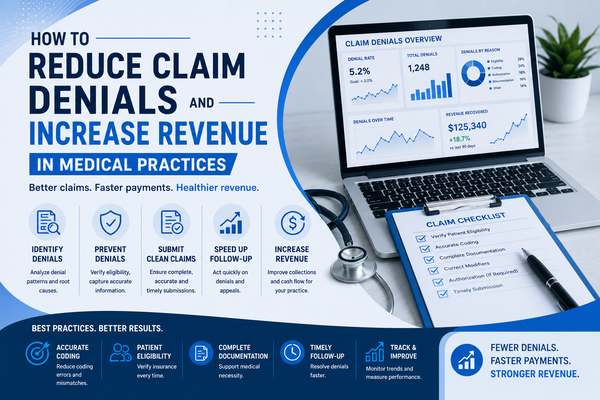
How to Reduce Claim Denials and Increase Revenue in Medical Practices
Claim denials are among the costliest yet most avoidable problems in today’s healthcare sector. Industry data consistently shows that a significant portion of initial claims are rejected upon first submission and that many practices never file an appeal, thereby forfeiting revenue they had already earned. For a mid-sized practice, this can result in the loss of tens of thousands of dollars annually not because care was unprovided or uncovered, but due to billing errors, missing modifiers, or documentation deficiencies earlier in the process.
The good news is that most denials can be prevented. By leveraging the right processes and technology and partnering with the ideal revenue cycle management (RCM) provider practices can significantly reduce denial rates and recover revenue that is currently being lost. Here is how to achieve that.
Why Claims Get Denied in the First Place
Before addressing the problem, it is helpful to understand where it originates. The most common triggers for denial include:
- Eligibility and registration errors: outdated insurance information, inactive coverage, or mismatched patient demographic data, detected only after the claim had been submitted.
- Missing or invalid authorization: services provided without the prior authorization or referral required in the records.
- Coding errors: incorrect CPT/ICD-10 codes, mismatched code pairs, missing modifiers, or outdated code sets.
- Incomplete documentation: clinical notes that do not support the medical necessity of the billed service.
- Timely filing violations: claims submitted after the deadline set by the payer, resulting in automatic denial regardless of their validity.
- Duplicate claims: Resubmissions resulting from unclear follow-up, flagged and rejected by payers' systems.
- Non-covered services: billed services that are not covered by the patient's specific plan benefits.
Each of these problems has a distinct root cause; precisely for this reason, a one-size-fits-all solution rarely works. Reducing denials requires addressing the process at every stage of the claim lifecycle, rather than simply correcting issues after a denial notification has been received.
1. Fix Eligibility and Registration at the Front Desk
A significant portion of claim denials originates before the claim is even coded. Verifying insurance eligibility and benefits prior to the appointment rather than after allows for the detection of inactive coverage, plan changes, and demographic discrepancies while they can still be corrected cost-effectively. Real-time eligibility verification tools integrated into your practice management system quickly pay for themselves by preventing denials at the source.
2. Strengthen Documentation and Coding Accuracy
Coding errors and documentation deficiencies are two of the most common and most easily remediable causes of claim denials. Medical practices should:
- Use certified coders who stay up to date with annual CPT/ICD-10 updates.
- Conduct a pre-submission review of claims to detect mismatched codes, missing modifiers, and incomplete fields.
- Ensure that clinical documentation clearly supports the medical necessity of each billed code.
- Audit coding accuracy regularly, not just when claim rejections increase.
3. Track Timely Filing Limits by Payer
Each payer has a different filing deadline; failure to meet it results in an otherwise valid claim being rejected with no possibility of appeal. Practices managing multiple payers require a system whether software-based or involving a dedicated accounts receivable team that alerts them to claims with upcoming filing deadlines well in advance of the due date.
4. Build a Real Denial Management Workflow
Denial management should not result in an inbox full of rejected claims that are processed "when there is time." Effective denial management requires:
- Categorize denials by reason code to identify patterns (e.g., is a specific payer, provider, or service line involved?)
- Assign responsibility so that each denial has a designated person tasked with resolving it within a set timeframe
- Submit appeals promptly: the longer a denial remains pending, the lower the likelihood of a successful recovery
- Conduct a root cause analysis to prevent the same denial from recurring month after month
This is where most practices quietly lose revenue: not due to a lack of effort, but because of the absence of a structured process to turn denials into recovered revenue rather than accounting losses.
5. Monitor the Right RCM Metrics
You cannot correct what you do not measure. Organizations that are serious about reducing denials should track:
- First-pass resolution rate: percentage of claims paid after the initial submission
- Denial rate by payer and reason code
- Days in accounts receivable (A/R): time elapsed until payment is received after claim submission
- Appeal success rate: frequency with which appealed claims result in payment
Analyzing the monthly evolution of these metrics reveals whether process changes are actually working and where the next bottleneck is hiding.
6. Consider a Specialized RCM Partner
For many practices, the fastest way to reduce denials and strengthen cash flow is not to hire more in-house staff, but to partner with a team specializing full-time in claims accuracy, denial management, and accounts receivable recovery. An experienced revenue cycle management (RCM) partner brings payer-specific expertise, dedicated appeals staff, and billing audits that identify issues before they turn into denials allowing your team to focus on patient care rather than managing outstanding collections.
The Bottom Line
Reducing claim denials is not achieved through a single solution; it requires optimizing every stage of the revenue cycle from front-end eligibility verification and coding accuracy to the implementation of a rigorous denial management workflow. Practices that invest in this process consistently experience fewer denials, faster collections, and a significant increase in collected revenue.
MedMaxBill, Inc. We specialize in medical billing audits, denial management, and revenue cycle administration for practices nationwide, with specific expertise in accounts receivable related to workers' compensation, no-fault insurance, and Letters of Protection (LOP). If claim denials are impacting your revenue, our team can conduct a complimentary revenue cycle management (RCM) audit to show you exactly where revenue leakage is occurring and how to stop it.
Ready to discover how much revenue you're missing out on? [Request your free Revenue Cycle Management (RCM) audit from MedMaxBill today.]
