


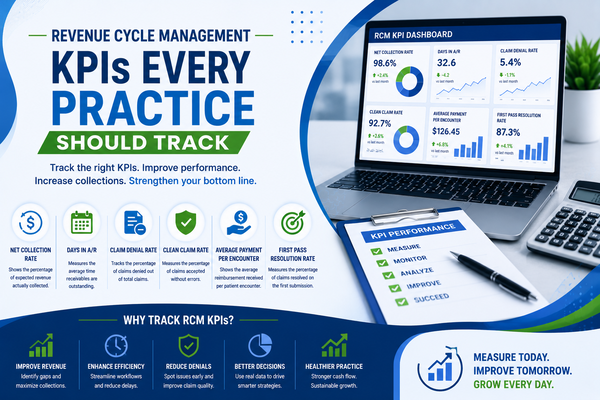
Revenue Cycle Management KPIs Every Practice Should Track
A healthy revenue cycle does not happen by chance; it is the result of constant monitoring, timely corrections, and data-driven decisions. However, many medical practices only scrutinize their billing performance once cash flow problems have already arisen. By then, the underlying issues have often been brewing for months.
The solution is simple in theory, though not always in execution: consistently track the right key performance indicators (KPIs) and address issues before they escalate. Below are the revenue cycle management KPIs that every practice should monitor, the importance of each, and the ideal benchmarks.
1. Clean Claim Rate (CCR)
What it measures: The percentage of claims accepted and paid upon initial submission, without the need for correction or resubmission.
Why it matters: A low rate of error-free (or "clean") claims indicates issues with eligibility verification, coding accuracy, or claim formatting factors that delay reimbursement and increase the administrative burden.
Healthy benchmark: 95% or more.
Formula: (Claims paid on first submission ÷ Total claims submitted) × 100
2. Days in Accounts Receivable (Days in A/R)
What it measures: The average number of days it takes to receive payment after filing a claim.
Why it matters: The longer money remains in accounts receivable, the greater its impact on cash flow and the more difficult it becomes to eventually collect. An increase in accounts receivable days often indicates slow payment processing, ineffective follow-up, or unresolved denials.
Healthy benchmark: Less than 40 days for most specialties, although targets vary depending on the payer mix.
3. Denial Rate
What it measures: The percentage of submitted claims that are denied by the payer.
Why it matters: A high denial rate directly delays revenue generation and increases collection costs, as denied claims require reworking, resubmission, or appeal.
Healthy benchmark: Below 5–10%, depending on the specialty and the payer mix.
Formula: (Number of denied claims ÷ Total claims submitted) × 100
4. First Pass Resolution Rate (FPRR)
What it measures: Like the clean claim rate, the FPRR measures the percentage of claims resolved that is, fully processed, whether correctly paid or denied without manual intervention on the first attempt.
Why it matters: This metric highlights the overall process efficiency across the entire claims workflow, not just at the acceptance stage.
5. Net Collection Rate
What it measures: The percentage of actual reimbursable revenue that a practice manages to collect, after accounting for contractual adjustments.
Why it matters: Unlike the gross collection rate, the net collection rate reflects how effectively a practice collects what is actually owed under payer contracts, making it one of the most accurate indicators of billing performance.
Healthy benchmark: 95% or more.
Formula: (Payments received ÷ (Charges − Contractual adjustments)) × 100
6. Cost to Collect
What it measures: The total operating cost required to collect one dollar of revenue, including expenses for personnel, software, and outsourced billing.
Why it matters: An increase in collection costs can indicate inefficiencies in the billing process even if collection levels remain stable signaling a need for improvements in processes or technology.
7. Charge Lag Days
What it measures: The time elapsed between the provision of a service and its invoicing.
Why it matters: The delay in charge entry postpones the entire revenue cycle, increasing the risk of denials due to late submission and slowing down overall cash flow.
8. Bad Debt and Write-Off Rate
What it measures: The percentage of billed revenue written off as uncollectible.
Why it matters: An increase in the rate of uncollectible account write-offs could indicate deficiencies in initial eligibility checks, patient billing processes, or collections follow-up.
9. Patient Collection Rate
What it measures: The percentage of patient-responsibility balances (copayments, deductibles, coinsurance) that are successfully collected.
Why it matters: As patient financial responsibility continues to rise, this key performance indicator (KPI) has become increasingly important to overall revenue performance.
Turning KPIs into Action
Tracking these metrics is only valuable if it leads to action. Best practices include:
- Reviewing KPIs monthly rather than just annually
- Segmenting metrics by payer, provider, and claim type to identify specific problem areas
- Establishing internal benchmarks and tracking trends over time, rather than relying solely on one-off analyses
- Assigning clear responsibilities for addressing recurring issues associated with each metric
- Using KPI trends to guide staff training and process improvements
Final Thoughts
Revenue cycle key performance indicators (KPIs) transform billing from a "black box" into a measurable, manageable process. Practices that systematically monitor metrics such as the clean claim rate, days in accounts receivable (A/R), denial rate, and net collection rate are far better positioned to detect issues early and safeguard their financial stability.
At MedMaxBill, Inc., we help practices monitor and improve the most critical KPIs, combining transparent reporting with hands-on revenue cycle management to maintain steady, predictable cash flow. If your practice needs greater visibility into its billing performance, our team is ready to assist you.
