


What Is Revenue Cycle Management in Medical Billing?
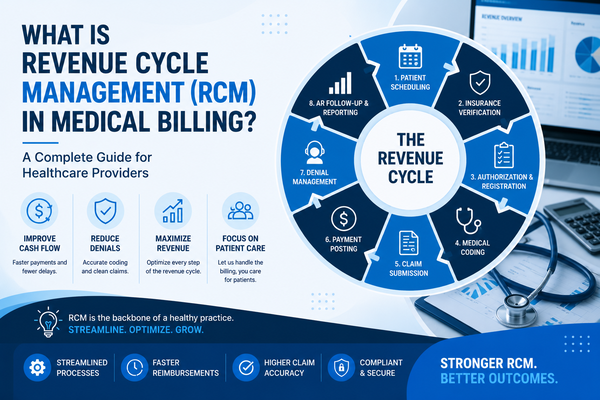
Behind every patient visit lies a financial process that determines whether the healthcare facility receives correct and timely payment. This process is known as Revenue Cycle Management (RCM) and forms the backbone of a medical practice's financial operations. Understanding RCM is essential for any healthcare provider or administrator seeking to maintain steady cash flow, reduce claim denials, and ensure the smooth operation of the business side of healthcare.
This article explains exactly what revenue cycle management entails, outlines its stages, and discusses why it is more important than ever in today’s healthcare landscape.
Revenue Cycle Management Defined
Revenue Cycle Management (RCM) is the comprehensive financial process healthcare organizations use to track patient care episodes, from initial appointment scheduling and registration to the final payment of the outstanding balance. It encompasses all administrative and clinical functions that contribute to capturing, managing, and collecting revenue generated from services provided to patients.
Simply put, RCM is the system that links patient care to payment for the medical practice or facility, ensuring that services provided by the professional translate into revenue actually received by the entity.
Why Revenue Cycle Management Matters
- Financial stability: A well-managed revenue cycle maintains predictable and steady cash flow.
- Fewer denied claims: Structured revenue cycle management (RCM) processes detect errors before they turn into denials.
- Reduced administrative burden: Optimized workflows mean spending less time on rework and appeals.
- Better patient experience: Transparent billing and accurate estimates improve patient trust and satisfaction.
- Regulatory compliance: Proper revenue cycle management (RCM) practices help ensure that billing complies with insurer and government requirements, thereby reducing audit risk.
The Key Stages of Revenue Cycle Management
1. Pre-Registration and Scheduling
The cycle begins even before the patient arrives, with the scheduling of the appointment and the initial collection of demographic and insurance information.
2. Insurance Eligibility and Verification
Before providing services, staff verify the patient's insurance coverage, benefits, and any prior authorization requirements to avoid subsequent denials.
3. Patient Registration
Accurate collection of patient demographic data, insurance information, and consent forms lays the foundation for an error-free claim later in the cycle.
4. Charge Capture
Every service, procedure, and billable material used during patient care is documented and translated into billing codes.
Certified coders assign accurate CPT, ICD-10, and HCPCS codes based on clinical documentation, ensuring that the claim reflects the services provided.
Coded claims are reviewed for errors and submitted electronically to the appropriate payer, in compliance with that entity's specific formatting and submission requirements.
7. Payer Adjudication
The payer reviews the claim, determines coverage, and issues payment, partial payment, or a denial based on the patient's benefits and the accuracy of the claim.
Payments received from payers and patients are recorded in the corresponding accounts, and any discrepancies are flagged for review.
Denied or rejected claims are analyzed, corrected, and resubmitted or appealed, while root causes are tracked to prevent recurring issues.
10. Patient Billing and Collections
Any remaining amount owed by the patient whether copayments, deductibles, or coinsurance is billed directly to the patient, and follow-up procedures are applied to outstanding balances.
11. Reporting and Analytics
Continuous analysis of key metrics such as the error-free claim rate, days in accounts receivable, and denial rate helps practices identify trends and improve their financial performance over time.
Common Challenges in Revenue Cycle Management
- Inaccurate or incomplete patient data at admission
- Coding errors or outdated code sets
- Missing prior authorizations
- Delayed or inconsistent claims follow-up
- Lack of visibility into key performance metrics
- Staffing shortages in billing departments
How Practices Can Strengthen Their Revenue Cycle
- Invest in eligibility verification tools to detect coverage issues early.
- Standardize data collection processes at the front desk.
- Use claims review software to reduce errors in initial submissions.
- Monitor denial trends by payer and root cause.
- Provide ongoing training for coding and billing staff.
- Partner with an experienced revenue cycle management (RCM) provider for specialized oversight and technology.
Final Thoughts
Revenue cycle management goes far beyond the simple submission of claims; it is a continuous, interconnected process encompassing all financial interactions between a healthcare facility, its patients, and payers. Facilities that treat this management as a strategic priority rather than merely an internal administrative task consistently achieve stronger cash flow, reduced claim denials, and greater financial sustainability.
At MedMaxBill, Inc., we manage the entire revenue cycle for healthcare providers from eligibility verification and coding to claim submission and denial management allowing professionals to focus on patient care while we ensure they receive accurate and timely payments.
