


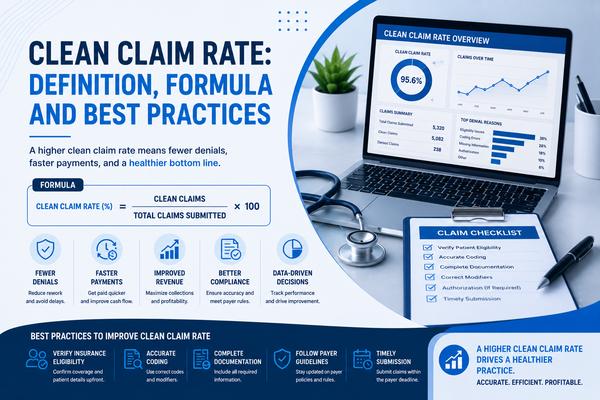
Clean Claim Rate: Definition, Formula and Best Practices
Every dollar a medical practice receives begins with a claim; when a claim is rejected or denied upon initial submission, the associated revenue is delayed by days or weeks. Consequently, the clean claim rate (CCR) is one of the most critical performance indicators in revenue cycle management. A high rate translates to faster payments, lower administrative costs, and increased profitability. Conversely, a low rate reveals hidden inefficiencies that quietly erode the practice's revenue.
In this article, we take an in-depth look at what the clean claim rate really means, how to calculate it accurately, and the best practices leading medical billing teams use to keep it at optimal levels.
What Is Clean Claim Rate?
The "Clean Claim Rate" is the percentage of medical claims submitted to a payer that are accepted for processing without the need for manual intervention, correction, or resubmission. A "clean claim" contains complete and accurate patient information, uses the correct coding, and meets all payer-specific requirements from the moment of initial submission.
If a claim is rejected due to missing data, coding errors, eligibility issues, or formatting errors, it is no longer considered "clean," even if it is eventually corrected and paid. This rate measures success on the first attempt, not the final outcome.
Why Clean Claim Rate Matters
- Faster reimbursement: Error-free claims move directly through the payer's adjudication process, shortening the revenue cycle.
- Lower administrative cost: Each reworked claim consumes staff time that could be devoted to higher-value tasks.
- Improved cash flow predictability: A clean claim rate (CCR) makes revenue forecasting more reliable.
- Reduced denial backlog: Fewer returned claims mean a reduced workload for billing and coding teams.
- Better payer relationships: claims consistently build trust among payers and can reduce audit scrutiny.
Industry standards typically place a healthy rate of "clean" (error-free) claims at 95% or higher. Facilities operating below 85% often exhibit systemic issues regarding initial data collection, coding accuracy, or pre-claim validation processes.
Clean Claim Rate Formula
The standard formula for calculating the clean claim rate is:
Clean claim rate (%) = (Number of claims paid on first submission ÷ Total number of claims submitted) × 100
Example: If your practice submitted 1,000 claims in a month and 930 of them were accepted and paid without the need for corrections or resubmissions, your clean claim rate would be:
(930 ÷ 1,000) × 100 = 93%
Tracking this on a monthly basis ideally broken down by payer, provider, and claim type helps pinpoint exactly where variances occur, rather than treating the CCR as a single, vague figure.
Common Reasons Claims Fail to Stay Clean
- Incomplete or inaccurate patient demographic or insurance information
- Eligibility and coverage not verified prior to the visit
- Incorrect or outdated CPT, ICD-10, or HCPCS codes
- Lack of prior authorization
- Discrepancy in provider or facility NPI numbers
- Duplicate claim submission
- Payer-specific formatting or filing deadline errors
Best Practices to Improve Clean Claim Rate
1. Verify Eligibility Before Every Visit
Real-time eligibility verification detects coverage gaps, inactive policies, and authorization requirements even before the claim is generated.
2. Standardize Front-Desk Data Capture
Errors made during the patient admission process are a leading cause of claim denials. The use of standardized admission forms and staff training significantly reduce this risk.
3. Use Claim Scrubbing Software
Automated claim review tools detect coding discrepancies, missing fields, and violations of payer-specific rules prior to submission, identifying errors that often go unnoticed by humans.
4. Keep Coding Accurate and Current
Periodically update coding references and provide ongoing training to certified coders to ensure that claims reflect current CPT/ICD-10 guidelines and payer policies.
5. Track Denials by Root Cause
Categorizing denials (eligibility, coding, authorization, timely filing, etc.) makes it possible to identify exactly where process improvements will have the greatest impact on the CCR.
6. Confirm Authorization Requirements Early
Integrate authorization controls into scheduling workflows so that procedures requiring prior approval are never submitted without it.
7. Audit Claims Before Submission
A pre-submission quality review whether manual or automated detects avoidable errors before they turn into denials.
8. Partner with an Experienced Billing Team
External revenue cycle management partners bring specialized expertise, dedicated quality control levels, and payer-specific knowledge resources that many in-house teams lack the capacity to maintain.
Final Thoughts
The Clean Claim Rate (CCR) is not merely a billing metric; it is a direct reflection of the efficiency of your revenue cycle operations. Practices that consistently monitor this rate, address the root causes of rejections, and optimize their front-end and coding processes achieve significantly faster reimbursements and lower administrative costs.
At MedMaxBill, Inc., we help medical practices nationwide improve their clean claim rates through accurate coding, real-time eligibility verification, and comprehensive revenue cycle management. If your practice is struggling with denied claims or slow reimbursements, our team can help you identify inefficiencies and establish a process that ensures the smooth operation of your revenue cycle.
