

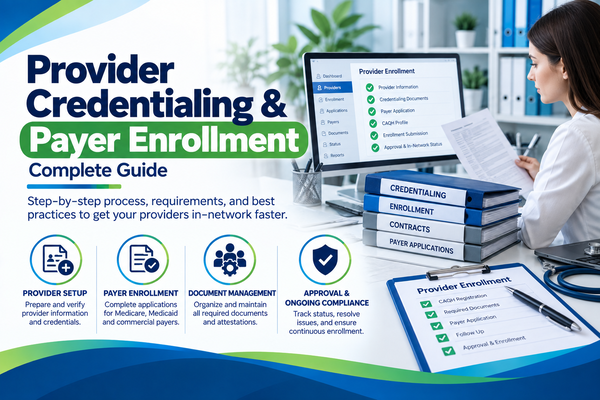
Provider Credentialing & Payer Enrollment: Complete Guide
A newly hired physician, advanced practice nurse, or therapist may have all their licenses in order, a full schedule, and be ready to see patients; yet, they might still be unable to process even a single insurance claim. The reason almost always lies in the credentialing and enrollment process with payers. These two procedures determine when a professional can legally participate in insurance networks and receive payment for the care they provide.
Because both processes are time-consuming, require a significant amount of documentation, and allow for absolutely no errors, they are among the most common hidden causes of revenue loss in medical practices. This guide explains what credentialing and enrollment entail, how they differ, what needs to be prepared, and how to ensure the process keeps moving forward.
What Is Provider Credentialing?
Credentialing of healthcare professionals is the process by which a practitioner’s qualifications are verified. A health plan, hospital, or credentialing organization examines the professional’s academic background, training, licenses, specialty certifications, employment history, record of professional malpractice, and any sanctions or disciplinary actions. The objective is to confirm that the professional possesses the necessary qualifications and is fit to provide care to the members of that health plan.
This process relies on primary-source verification; this means that the entity conducting the verification confirms credentials directly with the issuing source for example, the state licensing board or the relevant specialty certification board rather than relying solely on copies provided by the professional themselves.
What Is Payer Enrollment?
Enrollment with payers sometimes referred to as provider enrollment or contracting is the administrative process by which a provider or a group is added to a specific insurance plan. This process involves submitting applications, signing participation agreements, and obtaining the identifiers necessary to submit claims and receive payment for them.
In short, credentialing serves to verify that a provider is qualified, while enrollment enables that provider to bill for services. Although both processes are interrelated and many payers manage them as a single workflow a medical practice or facility requires both in order for claims to be reimbursed at in-network rates.
Why Credentialing and Enrollment Matter to Revenue
When a professional begins seeing patients before their enrollment process is complete, practices often face undesirable options: holding claims thereby delaying revenue billing under another professional (which carries regulatory compliance risks), turning patients away, or accepting the denial of payments. For a single professional, each month of delay can result in a significant amount of unbilled revenue.
The credentialing process also affects patient access. Plan members can only choose professionals who are part of the network and listed as active in the plan’s directory; consequently, any delay means that fewer patients are able to schedule appointments.
Key Players and Systems You Need to Know
NPI and NPPES
Every provider and organization needs a National Provider Identifier. This is issued through the National Plan and Provider Enumeration System and appears on every claim.
CAQH ProView
Most commercial payers obtain credentialing data from CAQH ProView, a centralized online profile where healthcare professionals store their professional information. The profile must be complete, accurate, and periodically re-certified typically every 120 days. Furthermore, it is essential to authorize the relevant payers to view this profile.
Medicare Enrollment and PECOS
Providers enroll in Medicare through the Provider Enrollment, Chain and Ownership System (commonly known as PECOS) or by submitting a paper application. Generally, individual providers use form CMS-855I, organizations use form CMS-855B, and form CMS-855R is used for the reassignment of benefits to a group. Medicare revalidation is typically required every five years, although for certain categories, the revalidation process must be completed more frequently.
Medicaid Enrollment
Medicaid enrollment is managed at the state level. In New York, providers enroll through the state’s Medicaid program and its managed care plans; additionally, each managed care plan may impose its own credentialing requirements.
Commercial Payers
Large commercial insurance companies each have their own application portals, documentation requirements, and contracting teams. Furthermore, some open or close their networks based on regional needs, which can limit the ability of a new provider to join them.
The Credentialing and Enrollment Process, Step by Step
Step 1: Gather Documents Early
Gather the professional’s licenses, DEA registrations and state controlled-substance registrations, professional board certifications, diplomas and training records, professional liability insurance certificate, an up-to-date curriculum vitae (CV) with no unexplained gaps, employment history, and references. Having everything prepared before submitting the application helps avoid the most common delays.
Step 2: Build or Update the CAQH Profile
Complete all sections, attach current documents, and provide a declaration of truthfulness. Many applications get held up because a single expired document or an incomplete field results in the file being returned to the provider.
Step 3: Confirm Network Availability
Before investing time in an application, verify whether each payer is accepting new providers in your specialty and region. Request enrollment forms or information regarding their provider panel directly from the payer.
Step 4: Submit Applications
Submit specific requests for each payer, along with supporting documentation. Maintain a tracking log that records the date of submission, the payer contact, the reference number, and all follow-up actions taken.
Step 5: Follow Up Consistently
Applications rarely move forward without consistent follow-up. Check their status regularly, respond to requests for documentation on the same day, and escalate the matter if expected deadlines pass without any updates.
Step 6: Review the Contract and Fee Schedule
Once approved, carefully review the participation agreement, including reimbursement rates, billing rules, deadlines for claim submissions, and termination conditions. This is also the time to confirm the effective date, as this determines which dates of service are eligible for payment.
Step 7: Load Data and Verify Before Billing
Following enrollment, confirm that the provider information has been correctly loaded into both your billing system and the payer's system. Whenever possible, submit a small test claim before proceeding to submit a full volume of claims.
Individual vs. Group Enrollment
Healthcare facilities often overlook the distinction between enrolling a healthcare professional as an individual and enrolling them as part of a group. Most payers require that the group’s tax ID and billing NPI be active; subsequently, each professional must be linked to that group to ensure that claims are processed and paid through the correct entity. Adding a new location, a change in ownership, or a modification to the tax ID may necessitate the submission of new applications or updates to each payer. Planning for these changes in advance and confirming the specific requirements of each payer helps prevent unexpected claim denials following an expansion a process that would otherwise be routine.
Realistic Timelines
Timeframes vary significantly depending on the payer; however, healthcare facilities should anticipate that the credentialing and enrollment process can, in many cases, span several months. Enrollment with Medicare typically takes a couple of months, while the process for commercial plans and Medicaid managed care plans can take anywhere from 60 to 120 days or even longer especially if applications contain errors or lack the necessary documentation. It is best practice to initiate the process as soon as a professional accepts a position, rather than waiting until their start date.
Some states, such as New York, regulate the timeframes within which health plans must process complete credentialing applications; therefore, it is advisable to consult with each plan regarding their expected turnaround times and any available escalation procedures.
Common Credentialing and Enrollment Mistakes
- Starting too late: Waiting until a healthcare professional’s first day on the job almost guarantees weeks or months during which billing will not be possible.
- Incomplete or outdated CAQH profiles: A failure to revalidate data and the presence of expired documents are among the primary causes of delays.
- Unexplained gaps in employment history: Payers typically require explanations when there are periods of inactivity that exceed a certain timeframe.
- Inconsistent information: Discrepancies in names, addresses, tax identification numbers, or NPI numbers—across applications, the CAQH profile, and the PECOS system lead to the rejection of credentialing or enrollment requests.
- Ignoring requests from payers: Failing to respond to requests for documentation can result in the closure of a file, requiring the entire process to be restarted.
- Overlooking credential renewal dates: Most health plans require credentials to be renewed approximately every three years; if this deadline passes, the professional may be excluded from the network.
- Lack of a tracking system: Without a centralized record, it is easy to miss important deadlines or neglect the follow-up of administrative processes.
Billing before the effective date. Claims for services provided prior to the approved effective date are typically denied.
Recredentialing and Ongoing Maintenance
Credentialing is not a one-time process. Providers must undergo periodic re-credentialing; licenses and certifications are renewed according to their own specific timelines; and professional liability coverage is updated annually. Practices must also promptly report any changes such as new locations, updates to tax identification numbers, or the departure of providers since outdated information can lead to denied claims and errors in provider directories.
An effective maintenance routine includes a calendar tracking all expiration dates, periodic CAQH re-attestation, reminders for Medicare revalidation, and regular audits of payer directory listings to ensure that provider information remains accurate.
Delegated Credentialing and Credentialing Services
Some larger groups and health systems qualify for delegated credentialing an arrangement in which a payer allows the organization to conduct the credentialing process on its behalf, in accordance with standards subject to audit. For smaller practices, an external credentialing service can offer a similar benefit by handling applications, follow-ups, and ongoing maintenance, thereby ensuring that clinical and administrative staff do not have to be diverted from patient care.
When evaluating a provider for credentialing management, ask how they track applications, how frequently they provide status updates, how they manage enrollments with CAQH and Medicare, and whether they also offer assistance with the re-credentialing process.
Best Practices Checklist
- Begin the process as soon as a provider is hired ideally, three to six months before their start date.
- Maintain a centralized file for each provider and update it as documents expire.
- Keep an accurate and properly certified profile in CAQH.
- Track every application, noting dates, points of contact, and reference numbers.
- Include all deadlines for re-accreditation, revalidation, and license renewal in your calendar.
- Confirm effective dates in writing, and do not submit any claims before those dates take effect.
- Verify that the provider’s information in your billing system matches the payer’s records exactly.
Final Thoughts
Credentialing and payer enrollment may happen in the background, but their impact on cash flow is immediate. Medical centers that approach these tasks as a planned, supervised process rather than treating them as an afterthought avoid revenue interruptions and are able to onboard their professionals more quickly.
At MedMaxBill, Inc., based in Levittown, New York, we assist medical centers with credentialing, payer enrollment, and revenue cycle management. If you are onboarding new professionals or experiencing delays in the enrollment process, contact MedMaxBill to learn how we can help your team start billing sooner and keep your records up to date at all times.
