


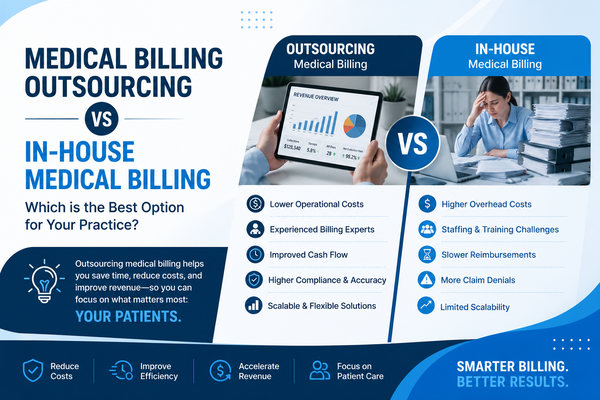
Outsourcing medical billing vs. in-house billing: which is the best?
Efficient medical billing is crucial to the financial success of any healthcare facility. As reimbursement regulations become more complex and claim rejection rates rise, providers face a key decision: should they handle billing in-house or partner with an external company specializing in medical billing?
Both in-house billing and outsourcing the service come with advantages and challenges. The right choice depends on factors such as facility size, budget, staffing resources, growth goals, and Revenue Cycle Management needs.
This guide examines the differences between outsourcing medical billing and managing it in-house, helping healthcare providers make an informed decision in 2026.
What Is In-House Medical Billing?
In-house medical billing refers to the management of all billing and revenue cycle activities within the healthcare organization.
An in-house billing team handles:
- Insurance verification
- Medical coding
- Claim submission
- Payment posting
- Accounts receivable follow-up
- Denial management
- Patient billing
- Revenue reporting
The healthcare facility directly hires, trains, supervises, and supports the billing staff.
What Is Medical Billing Outsourcing?
Outsourcing medical billing involves partnering with a specialized company that manages some or all aspects of the revenue cycle on behalf of a healthcare provider.
Typically, these external companies handle:
- Patient eligibility verification
- Medical coding
- Charge entry
- Claims submission
- Denial management
- Accounts receivable follow-up
- Payment posting
- Revenue reporting
- Regulatory compliance oversight
The provider retains visibility into performance, while experienced billing professionals manage day-to-day operations.
In-House Billing vs Outsourcing: Key Comparison Areas
1. Cost Comparison
In-House Billing Costs
Managing billing in-house entails significant expenses, including:
- Employee salaries
- Benefits and payroll taxes
- Staff training
- Office space
- Billing software
- Hardware and IT support
- Costs associated with staff turnover
These expenses can rise considerably as the practice or business grows.
Outsourced Billing Costs
Most medical billing companies charge a percentage of collections or a flat fee for the service.
Benefits include:
- Lower overhead costs
- No hiring costs
- Reduced technology expenses
- Minimal training requirements
- Predictable billing costs
Winner: Outsourcing
For many small and medium-sized firms, outsourcing often offers a lower total cost of ownership.
2. Expertise and Industry Knowledge
In-House Billing
In-house teams may possess solid practical knowledge but can struggle to keep up with:
- Coding updates
- Changes in payer policies
- Regulatory requirements
- New reimbursement models
Ongoing training requires additional investment.
Outsourced Billing
Professional billing companies employ specialists dedicated exclusively to revenue cycle management.
Their teams typically include:
- Certified coders
- Billing specialists
- Denial management experts
- Credentialing professionals
- Compliance specialists
Winner: Outsourcing
Specialized expertise often translates into greater billing accuracy and improved reimbursement performance.
3. Claim Denial Management
In-House Billing
Limited staff and resources can hinder the timely and systematic management of denials.
Common challenges include:
- Delayed appeals
- Incomplete follow-up
- Failure to meet filing deadlines
- Revenue loss
Outsourced Billing
Specialized denial management teams proactively identify denial trends and manage claim recovery.
Benefits include:
- Faster appeals
- Lower denial rates
- Improved reimbursement recovery
- Better communication with insurers
Winner: Outsourcing
Effective denial management typically translates into higher revenue collection.
4. Revenue Cycle Performance
In-House Billing
Revenue cycle performance depends heavily on staff experience, workload, and available technology.
Performance can fluctuate due to:
- Staff turnover
- Staff shortages
- Training deficiencies
- Workflow inefficiencies
Outsourced Billing
Billing companies employ established processes, advanced software, and specialized teams to optimize performance.
This typically translates into:
- Faster reimbursements
- Higher rates of error-free claims ("clean claims")
- Reduced days in accounts receivable
- Stronger cash flow
Winner: Outsourcing
Most medical practices improve revenue cycle efficiency through outsourcing.
5. Compliance and Security
In-House Billing
Healthcare organizations are responsible for maintaining compliance with:
- HIPAA regulations
- Coding guidelines
- Medicare requirements
- Commercial payer policies
Compliance management requires ongoing oversight and training.
Outsourced Billing
Reputable billing companies invest significantly in:
- HIPAA compliance
- Data security protocols
- Regulatory updates
- Staff training
This reduces compliance risks for providers.
Winner: Outsourcing
Experienced billing partners typically offer more robust compliance support.
6. Technology and Automation
In-House Billing
Medical practices must acquire, maintain, and update:
- Billing software
- Clearinghouse services
- Analytics platforms
- Security infrastructure
Technology investments can be costly.
Outsourced Billing
Most billing companies use advanced technologies, such as:
- Automated claim review
- AI-assisted coding tools
- Eligibility verification systems
- Revenue analytics dashboards
- Denial tracking platforms
Winner: Outsourcing
Suppliers gain access to enterprise-grade technology without making large investments.
7. Scalability
In-House Billing
As patient volume increases, practices must hire additional staff and expand their infrastructure.
Growth can entail:
- Increased operating costs
- Hiring challenges
- Training needs
Outsourced Billing
Outsourced teams can often scale services rapidly without disrupting operations.
Benefits include:
- Flexible support for growth
- No need for new hires
- Consistent performance during expansion
Winner: Outsourcing
Outsourcing offers greater flexibility for growing practices.
Advantages of In-House Medical Billing
Despite its challenges, internal invoicing offers certain advantages.
Greater Direct Control
Providers have immediate oversight of billing operations and staff activities.
Internal Communication
Billing staff work closely with providers and clinical teams.
Custom Workflow Management
Billing staff work closely with providers and clinical teams.
Strong Organizational Familiarity
In-house teams often understand the practice's unique workflows and patient population.
Advantages of Medical Billing Outsourcing
Outsourcing offers several strategic advantages.
Reduced Administrative Burden
Providers spend less time managing billing staff and operational matters.
Improved Collections
Billing specialists focus on maximizing reimbursements.
Access to Experts
Providers gain access to experienced specialists in coding, billing, and denial management.
Enhanced Reporting
Professional billing companies typically provide detailed performance reports and key performance indicator (KPI) dashboards.
Focus on Patient Care
Healthcare professionals can devote more time to clinical responsibilities rather than administrative tasks.
When In-House Billing May Be the Better Choice
In-house billing may be suitable for:
- Large healthcare organizations
- Hospital systems
- Medical practices with highly experienced billing departments
- Organizations seeking maximum operational control
These organizations typically possess the resources needed to maintain a robust in-house billing operation.
When Outsourcing May Be the Better Choice
Outsourcing medical billing is often ideal for:
- Independent physicians
- Specialty practices
- Multi-provider clinics
- Ambulatory surgery centers
- Behavioral health centers
- Emerging healthcare organizations
These providers often benefit from increased efficiency and reduced operating expenses.
Questions to Ask Before Choosing a Billing Model
Before making a decision, healthcare providers should consider:
- What are our current payment denial rates?
- How much do we spend on billing operations?
- Do we have qualified billing staff?
- Can we adapt to regulatory changes?
- Are we meeting our revenue goals?
- How quickly are claims paid?
- Do we have the technology needed for optimal performance?
The answers can help determine whether outsourcing or maintaining an in-house team is the best long-term strategy.
How MedMaxBill, Inc. Supports Healthcare Providers
At MedMaxBill, Inc., we offer comprehensive medical billing and revenue cycle management solutions for healthcare providers across the United States.
Our services include:
- Insurance eligibility verification
- Medical coding
- Claims submission
- Denial management
- Accounts receivable follow-up
- Payment posting
- Revenue cycle reporting
- Compliance support
Our experienced team helps providers reduce administrative burdens, improve collections, and achieve better financial performance, allowing them to focus on delivering exceptional patient care.
Conclusion
Choosing between outsourcing medical billing and managing it in-house is a significant decision that directly impacts the financial success of a medical practice or facility.
While in-house billing offers greater control, outsourcing provides access to specialized expertise, advanced technology, improved scalability, and often higher reimbursement rates. For many healthcare organizations in 2026, outsourcing has become a strategic solution to reduce costs, minimize claim denials, and strengthen revenue cycle management.
By carefully evaluating your facility's goals, resources, and revenue cycle challenges, you can determine the billing model that best supports long-term growth and profitability.
